
Improved Crawlability
Make priority pages easier for bots to find and reach.
We strengthen the technical foundation behind your search visibility — from crawlability and indexing to Core Web Vitals, structured data, JavaScript rendering and site architecture.
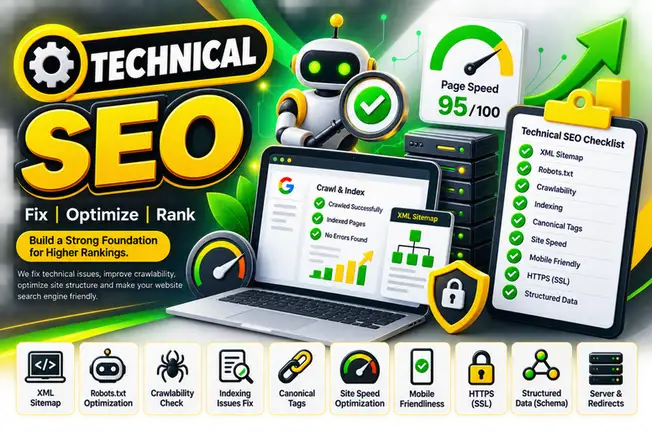 Crawlability
Indexability
Core Web Vitals
Crawlability
Indexability
Core Web Vitals

Technical SEO makes it easier for search engines to discover, render, understand and index the pages that matter. A strong technical foundation supports content, links and conversion-focused pages instead of quietly holding them back.
Make priority pages easier for bots to find and reach.
Reduce technical friction across key templates and devices.
Keep valuable URLs indexable while controlling low-value variants.
Align HTTPS, redirects, canonicals and preferred site versions.
Maintain technical quality across mobile rendering and interaction.
Use structured data and architecture to improve machine understanding.
Each audit area is connected. We prioritize the issues most likely to block crawling, indexing, usability, performance or scalable site growth.
Find crawl, indexation, architecture and technical quality issues before changes begin.

Make important pages easier for search engines to discover, access and understand.

Resolve signals that keep valuable pages out of search or create unnecessary index bloat.

Improve load performance and remove avoidable technical friction across critical templates.

Improve mobile rendering, usability and technical parity so mobile visitors and crawlers get the right experience.

Keep canonical site versions secure, consistent and accessible without mixed-content or protocol confusion.
Add and validate relevant structured data so search engines receive clearer entity and page context.

Keep XML sitemaps focused on valuable indexable URLs and aligned with the site architecture.
Consolidate duplicate signals and create cleaner URL patterns that are easier to crawl and manage.

Repair broken paths and simplify redirect logic so users and bots reach the correct destination efficiently.
Improve experience-focused technical performance across LCP, INP and CLS without sacrificing functionality.

Strengthen crawl paths and hierarchy with deliberate internal links to priority service and conversion pages.
Review rendered content, client-side navigation and script-dependent elements that can affect crawling and indexing.

Understand how search-engine bots actually crawl the site and where crawl activity is being wasted.

Align language and regional versions so search engines can serve the right page to the right market.
Technical SEO is not about collecting warnings. It is about separating harmless noise from issues that can affect crawling, indexing, rendering, speed or page quality.
Map broken and moved URLs directly to the most relevant live destination.
Reduce conflicting preferred-URL signals across parameters, variants and generated paths.
Check whether essential content and links exist in the rendered experience search engines receive.
Use server activity to see what crawlers actually request, ignore or revisit.
We diagnose first, prioritize by impact, fix methodically and validate after implementation so changes do not create new technical problems.
Review crawl, indexation, architecture, performance and technical signals.

Separate urgent blockers from lower-impact cleanup and improvement work.
Implement or document the technical changes required for each issue.

Re-crawl, inspect and test changes before treating the issue as resolved.

Watch recurring issues, coverage changes, performance and future releases.
Clear answers to the questions businesses usually ask before a technical SEO audit or implementation project.

Technical SEO improves the infrastructure and signals that help search engines crawl, render, understand and index a website correctly. It includes areas such as architecture, redirects, sitemaps, robots directives, structured data, performance and mobile rendering.
The exact scope depends on the website, but a technical review can cover crawling, indexation, canonicals, XML sitemaps, robots.txt, redirects, 404s, Core Web Vitals, mobile usability, JavaScript rendering, schema, internal linking, HTTPS and international signals.
It depends on the size of the website, the platform and the severity of the issues. Some fixes are quick, while migrations, architecture changes and large indexation cleanups can require multiple implementation and validation cycles.
No. Technical SEO removes barriers and strengthens the foundation for search performance, but rankings also depend on content quality, intent match, competition, authority and many other factors.
Yes. Technical recommendations can be organized into clear implementation priorities so your developers, agency or internal team can execute them with less ambiguity.
On-page SEO focuses mainly on page content, relevance, headings, metadata and internal optimization. Technical SEO focuses on the infrastructure and signals that determine whether pages can be efficiently crawled, rendered, indexed and served.

Get a clear technical SEO roadmap for crawlability, indexing, speed, redirects, schema, mobile rendering and site architecture — prioritized by what matters most.