

Search Visibility
Clearer page signals help search engines understand relevance and connect the right query with the right page.
We improve the content, structure, HTML signals and internal pathways search engines use to understand your pages — while keeping the experience clear, useful and conversion-focused for real visitors.
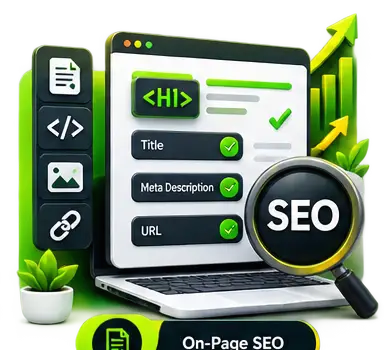
On-page SEO connects search intent, content quality, HTML structure and user experience so a page clearly communicates what it is about, who it helps and what visitors should do next.
Clearer page signals help search engines understand relevance and connect the right query with the right page.

Better structure, scannability and intent alignment make pages easier for visitors to navigate and trust.

Keyword-to-page mapping helps attract visitors who are looking for the specific solution your page provides.

Well-optimized pages give internal links, backlinks and broader authority-building efforts a stronger destination.
On-page SEO is not about inserting keywords. It is about making the page more relevant, complete, readable and useful while removing ambiguity for search engines and visitors.
Match the page to the problem, query and expected answer.
Organize information so visitors can understand and act quickly.

Improve the page signals that support visibility for relevant searches.

Connect organic intent with a clearer next step and stronger page flow.
Each page gets a clear keyword role, cleaner structure and stronger internal context — without sacrificing readability or the brand experience.

Map primary, secondary and semantic terms to the correct page based on search intent and business relevance.

Create clearer SERP messaging designed to match intent and improve click quality.

Build a logical H1, H2 and H3 hierarchy that improves scanning and topical clarity.
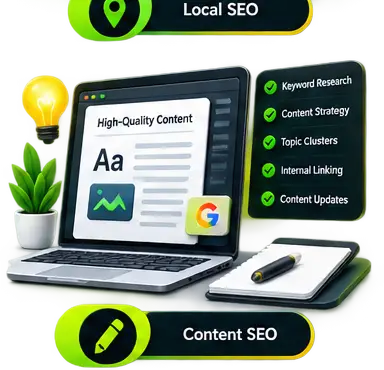
Improve usefulness, depth, semantics, readability and decision-stage content around the real search need.

Keep URLs concise, descriptive and aligned with the page topic and site architecture.

Optimize filenames, alt text, dimensions and loading behavior so images support both UX and discoverability.

Connect related services, resources and conversion pages with contextual links that improve discovery and topical relationships.

Recommend relevant structured data so search systems can interpret page entities and content more clearly.
We also review the signals that turn a page from “optimized” into genuinely useful search content.
Informational, commercial and transactional intent mapped to the correct page purpose.
Review the search result promise so title and snippet match what the page actually delivers.
Cover important concepts, entities, subtopics and natural language without keyword stuffing.
Add the sections, answers, proof and decision support needed for the query and buying stage.
Improve section length, hierarchy, scanning, mobile readability and content rhythm.
Place relevant CTAs and supporting information where they make sense in the visitor journey.
We begin with diagnosis, prioritize the highest-impact page issues, then refine and monitor the work over time.

Review page structure, metadata, content quality, links, schema and UX signals.

Confirm search intent, keyword role, competing pages and missing semantic coverage.
Improve content, headings, metadata, links, images and structured data recommendations.

Verify consistency, readability, page intent, mobile experience and implementation quality.

Use search performance data to refine pages that gain impressions, traffic and opportunities.
We use search performance, crawl data, SERP research and structured page reviews to identify what needs attention first.
 FREQUENTLY ASKED QUESTIONS
Clear answers about what we optimize and how on-page work fits into a broader SEO strategy.
Typical work includes search intent, keyword mapping, title/meta tags, headings, content optimization, URLs, internal links, image SEO, schema guidance, readability and conversion flow.
The initial optimization can be completed as a focused project, but important pages should be reviewed as search demand, competitors, content and business priorities change.
Content can be restructured, expanded or rewritten when the page needs stronger intent alignment, clearer messaging or better coverage. The scope depends on the page and project.
No. On-page SEO improves page quality and relevance, but rankings also depend on competition, technical health, authority, links, content quality and other search factors.
Yes. Existing service pages, landing pages, product/category pages and content can be audited and optimized without rebuilding the entire website.
Get a focused review of your page structure, content, metadata, internal links and search intent — with practical priorities for improvement.