
Acquire qualified buyers
Use the right channel for intent, product type and customer stage instead of forcing every store into one ad platform.
Multi-channel ecommerce growth across Meta, Google Shopping, TikTok and Shopify-native acquisition — connected to product feeds, conversion tracking, CRO, AOV, retention and profit-focused reporting.
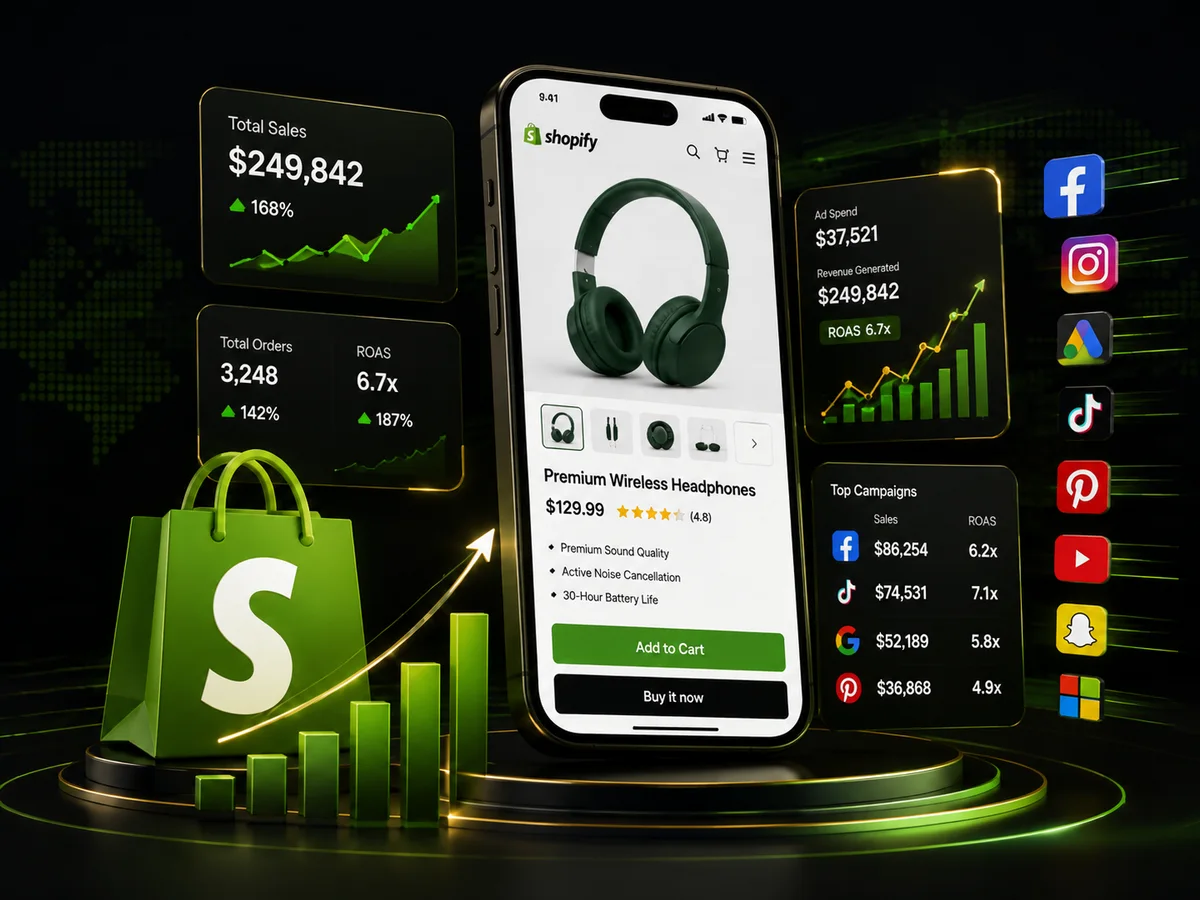
Strong Shopify acquisition depends on channel mix, first-party conversion signals, clean product data, fast product pages, clear checkout economics and lifecycle follow-up after the first purchase.
Use the right channel for intent, product type and customer stage instead of forcing every store into one ad platform.
Pixel/CAPI, Google conversions, GA4 and revenue values help campaigns learn from real customer actions.
Ad creative cannot compensate for weak product detail pages, mobile UX, cart friction or an unclear checkout journey.
AOV, subscriptions, repeat purchase and lifecycle messaging can make acquisition economics significantly healthier.

Review the offer, product economics, store funnel, tracking, feeds and current campaign structure before scaling spend.

Facebook and Instagram acquisition with Advantage+, catalog/DPA, Reels-style creative, new-customer focus and structured retargeting.

Merchant Center feed quality, Shopping intent capture, Performance Max asset groups, conversion goals and profitability-aware segmentation.

Short-form product creative, prospecting, retargeting and shop-led purchase journeys designed around mobile-first ecommerce behavior.

Visual product discovery campaigns for categories where shoppers actively save, compare and plan purchases.

Product-led video, remarketing and demand creation that supports search, Shopping and broader ecommerce acquisition.

Mobile-first creative and audience testing for stores where younger customer segments are commercially relevant.

Use conversion, margin, feed and creative signals to identify products and offers that deserve more acquisition budget.

Improve message match, product detail pages, mobile UX, trust, cart flow, Shop Pay and checkout friction after the ad click.

Increase revenue per order with relevant bundles, cross-sells, post-purchase offers and merchandising that protects customer experience.

Verify Meta Pixel/CAPI, Google conversions, GA4 events, revenue values and attribution inputs before judging campaign performance.

Segment product viewers, cart abandoners, checkout abandoners and past customers instead of showing every warm shopper the same ad.

Connect paid acquisition to welcome, abandoned-cart, post-purchase, replenishment, win-back and promotional lifecycle flows.

Build a repeatable creator-content pipeline and amplify suitable UGC through paid ads while tracking the commercial outcome.

Scale around contribution margin, CAC, product availability and new-customer value instead of chasing platform ROAS in isolation.

Support recurring and replenishment models with retention-aware acquisition, repeat-purchase journeys and customer-value segmentation.

Plan market expansion around localized offers, currencies, shipping realities, catalog structure and regional campaign economics.

Keep product IDs, titles, images, availability, variants and pricing aligned across Shopify, Merchant Center and advertising catalogs.

Report CAC, new-customer ROAS, MER, AOV, LTV, repeat purchase rate, revenue and profit context — not vanity clicks alone.
Prospecting, catalog/DPA, Reels creative and retargeting.
Merchant Center feed quality, purchase value and intent capture.
Short-form creative, shop journeys and mobile-first product discovery.
Shopify-native acquisition options where available, controlled around customer acquisition economics.
First-party commerce audiences for eligible Shopify Plus merchants; availability depends on Shopify eligibility and market.
Creator sourcing, UGC production and commercial tracking through a repeatable workflow.
Shopify Audiences note: availability is eligibility-dependent and is not presented as a feature every merchant automatically receives.
Reporting should connect media spend to customer acquisition, order economics and customer value. That creates better scaling decisions when channel attribution is imperfect.
For many Shopify stores, healthier economics come from increasing what a customer is worth after acquisition — not only from reducing the first-click cost.
Reduce avoidable friction across mobile cart and checkout while preserving clear shipping, payment and trust information.
Coordinate retargeting, email and SMS around shopper intent instead of duplicating the same message across every channel.
Increase order value with relevant merchandising rather than aggressive upsells that damage trust.
Use Shopify Collabs or other suitable workflows to build creator supply, customer proof and reusable paid-social creative.
Review margin, AOV, customer value, conversion events, feeds and current channel performance.
Select products, bundles, landing paths and creatives with the strongest commercial case to test.
Separate prospecting, retargeting, creative tests and product groups so learning is interpretable.
Fix message match, product pages, cart friction and checkout issues revealed by campaign behavior.
Increase spend where stock, contribution margin and customer value support sustainable growth.
Review CAC, MER, NC-ROAS, AOV, LTV and repeat behavior, then set the next month’s priorities.
The right answer depends on store economics, product demand, tracking and conversion quality — not a universal ad formula.
No. The strategy can combine Meta, Google Shopping and Performance Max, TikTok, YouTube, Pinterest, Snapchat, Shopify-native acquisition options and retention channels when they fit the store.
Usually the biggest constraint is one of four areas: tracking, product/feed quality, creative and offer strength, or the product-page/checkout journey. The audit identifies the highest-leverage issue first.
Yes. Product titles, images, variants, availability, pricing, product IDs and catalog synchronization are part of the ecommerce advertising system when relevant.
The page covers Meta Pixel and Conversions API, Google conversion tracking and GA4 ecommerce events. The exact setup depends on the store theme, apps, checkout configuration and privacy requirements.
It is a Shopify first-party audience product available only to eligible merchants. We treat it as an optional acquisition layer, not a guaranteed feature for every Shopify store.
No. Performance depends on product demand, margin, price, offer, creative, competition, website conversion rate, tracking quality, inventory and budget. The focus is disciplined testing and measurable business economics.
Share your store, current channels and commercial goal. The audit can identify the most useful next step without promising guaranteed sales or a fixed ROAS.